

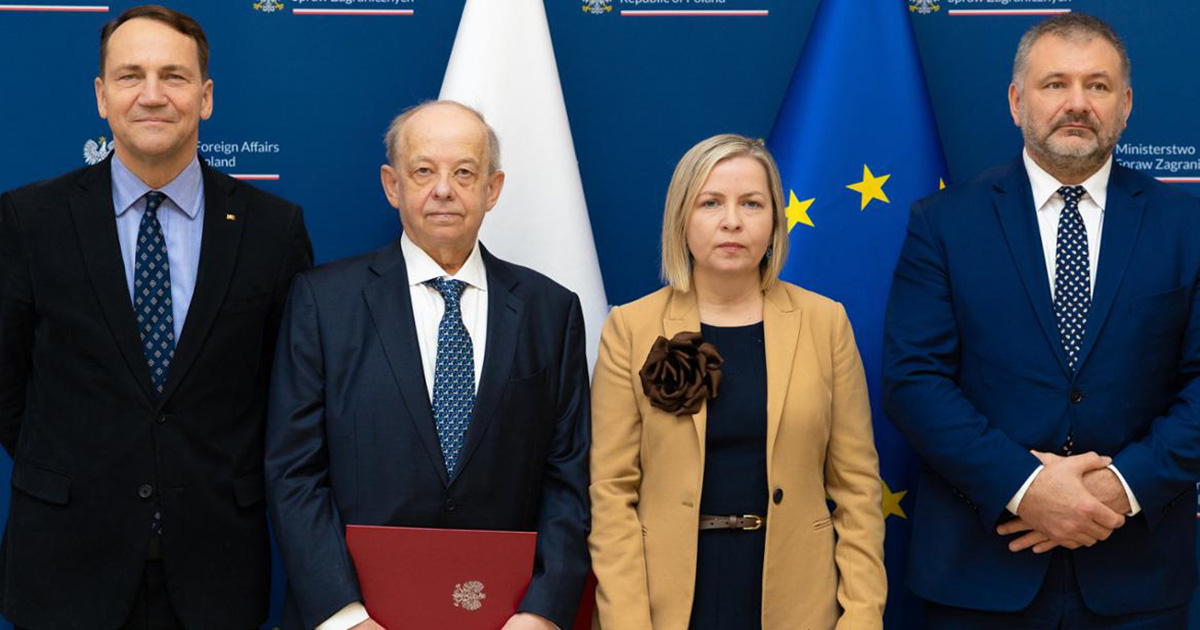
The Government of the Republic of Poland has announced the appointment of new Polish representatives to the Venice Commission: Prof. Wojciech Sadurski and Prof. Monika Florczak-Wątor. Both are renowned experts in the field of constitutional law, whose academic achievements are recognised throughout Europe.
In accordance with the Commission's Statute, its members should be persons of the highest qualifications, guaranteeing independence and outstanding knowledge in the field of constitutional and international law. Guided by these criteria, together with the Ministry of Justice, we have decided to entrust this responsible function to eminent Polish experts whose achievements and experience are recognised in Europe, said Radosław Sikorski, Deputy Prime Minister and Minister of Foreign Affairs, during the ceremony.
Heraclitus of Ephesus once warned that laws should be guarded like the walls of one's hometown, because only behind them can one live safely. I believe that the involvement of Poland's new representatives in the work of the Venice Commission will make a real contribution to strengthening these walls, the standards of democracy, the rule of law and the protection of human rights throughout Europe," continued Deputy Prime Minister Radosław Sikorski.
Prof. Wojciech Sadurski is a constitutional lawyer and professor of law at the University of Sydney and the European Centre at the University of Warsaw. He specialises in constitutional law, legal theory and human rights. He is a distinguished researcher of the mechanisms of democracy, authoritarianism and the protection of fundamental rights. His publications are often used as a reference point in discussions on the state of the rule of law in Europe.
Prof. Monika Florczak-Wątor, PhD, professor at the Jagiellonian University, heads the Department of Constitutional Law at the Faculty of Law and Administration of the Jagiellonian University. She deals with issues of individual rights and freedoms, the functioning of the Constitutional Tribunal, and standards of constitutional protection in Poland and Europe. She is the author of numerous scientific studies and expert opinions in the field of public law.
Minister of Justice Waldemar Żurek emphasised that the candidates presented guarantee the highest substantive and ethical standards.
‘These are people who are highly respected in the legal community, with established achievements and, what is particularly important for us, who are absolutely independent. Independence is the foundation for rebuilding trust in the state and its institutions,’ he emphasised.
The head of the Ministry of Justice pointed out that the Venice Commission remains one of the most important European reference points in the field of the rule of law.
‘After the experiences of recent years, we want to show that Poland is capable of restoring the standards of the rule of law in full compliance with the Constitution and European law. Today's appointment is an important part of this process and proof that we have worthy representatives in key international bodies,’ Minister Żurek noted.
Professor Wojciech Sadurski emphasised that he considers joining the Venice Commission a special honour and commitment.
"The very name “Democracy through Law” expresses profound wisdom. We can argue about different models of democracy – there are many of them in Europe – but the rule of law is the common denominator and the minimum consensus in constitutional language. It is not just a technical principle or a subject of dispute among lawyers, but above all a moral promise by the authorities to citizens that the law will not be used instrumentally," he noted.
Prof. Monika Florczak-Wątor said that:
Today, in times of constitutional crises, growing political tensions and the instrumental use of the law, the Commission's role in monitoring the quality of the rule of law and strengthening the independence of the judiciary and the protection of individual rights is particularly important. Poland's presence in this body is an expression of its readiness to co-create European standards of the rule of law, she noted.
The professor also expressed her satisfaction with the opportunity to continue the work of Polish representatives in the Commission, including Prof. Hanna Suchocka, and declared that she intends to use her research experience on the quality of democracy in her work.
What is the Venice Commission?
The Venice Commission, officially known as the European Commission for Democracy through Law, is the most important advisory body of the Council of Europe, operating since 1990. The Commission's opinions form the basis for European standards of the rule of law.
The Commission supports member states in strengthening the rule of law, constitutional democracy and the protection of human rights. It prepares opinions and expert reports on constitutions, constitutional laws and changes to judicial systems.
Each member state of the Venice Commission delegates one member and one alternate, appointed from among eminent experts in constitutional or international law.
Candidates are nominated by the government of the respective country and their appointment is approved by the Committee of Ministers of the Council of Europe for a four-year term, with the possibility of reappointment.
The newly appointed experts will serve as members of the Venice Commission representing Poland, participating in the work on opinions and recommendations concerning democratic and legal standards in the member states of the Council of Europe.